
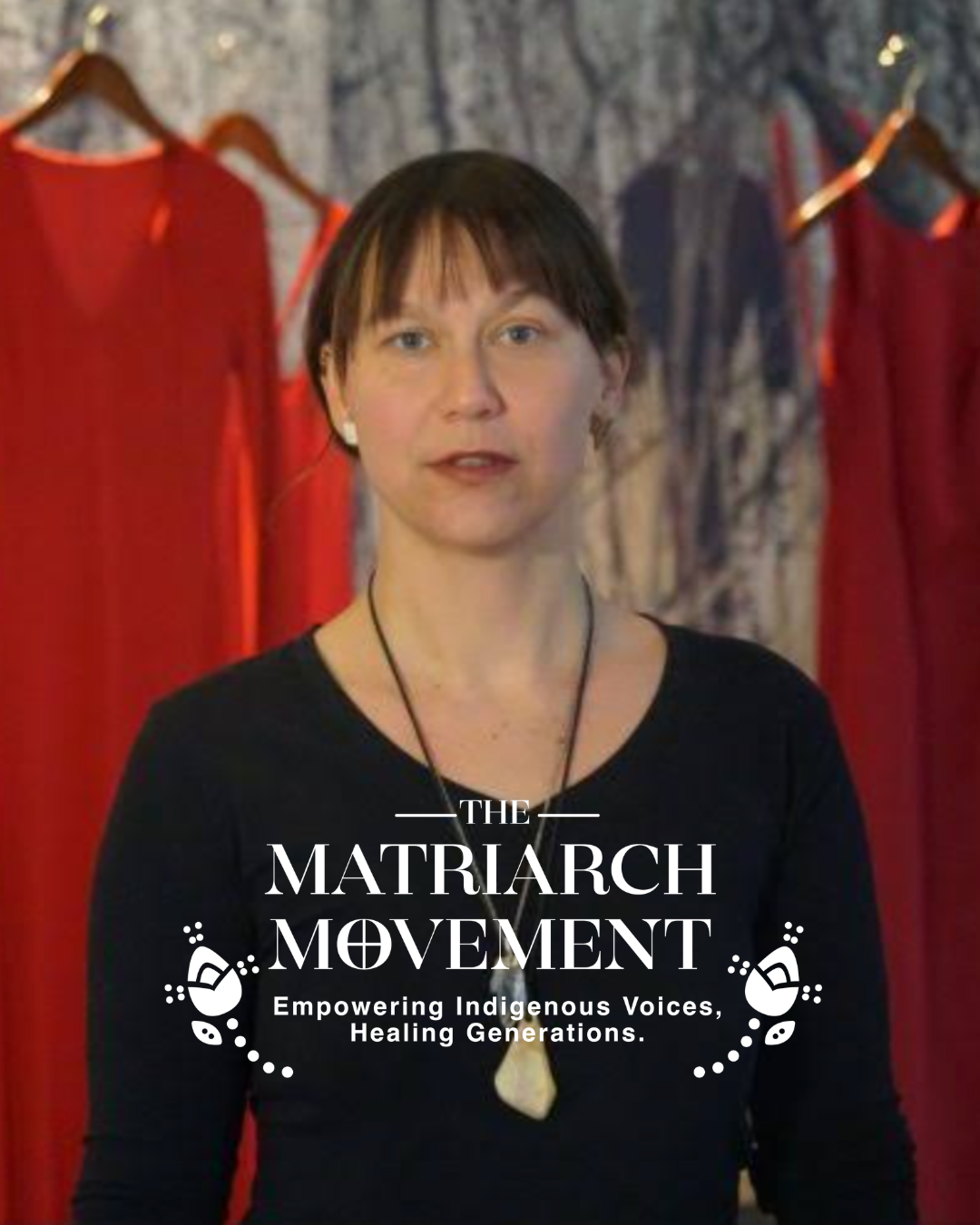
Meet Jaime Black
On this episode of the Matriarch Movement podcast, host Shayla Oulette Stonechild sits down with Jaime Black on the unceded Coast Salish territories of the xʷməθkʷəy̓əm (Musqueam), Sḵwx̱wú7mesh (Squamish) and səlilwətaɬ (Tsleil-Waututh) Nations, also known as Vancouver. This is part of Season 6, Indigenous Voices of This Generation, made in partnership with the Indigenous Screen Office and YouTube Canada.
Jaime is a Red River Métis multidisciplinary artist and activist of Anishinaabe and Finnish descent. She lives and works on her home territory near the confluence of the Red and Assiniboine rivers in Manitoba. She founded the REDress Project, an art installation of empty red dresses responding to the crisis of Missing and Murdered Indigenous Women, Girls and Two-Spirit people across Turtle Island. Her work inspired Red Dress Day, the national day of awareness held every May 5.
Over the past decade, Jaime has expanded her practice into the body, the land and the water, exploring healing, memory, identity and reconnection as acts of resistance in their own right.
What follows is a conversation about art as activism, the power of women, healing with water, and what it means to be part of a long line of matriarchs.
The land as Co-Creator
Jaime’s grandparents and great-grandparents are from the same land she lives on today, where the Red and Assiniboine rivers meet. For thousands of years, people from across Turtle Island gathered at that confluence. Many call Winnipeg the heart of Turtle Island.
That history shapes everything she makes. Her practice, she says, is about listening and paying attention: walking the same trails and riverbanks over and over, and learning almost by osmosis. She sees the land as a co-creator, working with water, fire and movement in ways she cannot fully control.
Winnipeg carries some of the highest rates of violence against Indigenous women in Canada. It also has the largest urban Indigenous population of any Canadian city, and a strong Indigenous voice that runs through her work.
“It really just reminds me what I’m made of.”
Where the REDress Project began
Jaime remembers turning 12 and feeling the pressure to shrink, to step back and hold less power now that she was a young woman. She saw it happening to the women all around her, and she refused it. Ironically, she says, working with red dresses led her to realize women’s power and presence, not only the violence against us.
There was no single starting point for the REDress Project, and Jaime shares many of its origin stories in her new book, REDress: Art, Action and the Power of Presence. One moment she returns to often is a public performance she witnessed in Colombia. About 300 women who had lost loved ones filled a public square, calling out names their news would not report. Forty of them, dressed in red, danced to a traditional song while searching and calling for the missing.
Witnessing that fierce energy changed her path. She had been on her way to becoming a teacher, but she realized that if this is what art can do, she needed to bring that gift home.
The image itself came to her while listening to a professor from First Nations University speak about MMIWG2S+: red dresses everywhere, covering the ground at the Legislature and in Ottawa. She believes it was seeded years earlier by The Book of Jessica by Maria Campbell and Linda Griffiths, which she read again and again at 17. Its cover features a painting of an empty red dress by Ruth Cuthand.
Today, seeing that vision carried across the country is a reminder of grassroots power: the people on the ground can make change, despite everything trying to stop us.
How we can all show up
When asked how Indigenous and non-Indigenous people can support the movement, Jaime points first to the National Inquiry into Missing and Murdered Indigenous Women and Girls. Its final report, available online, includes 231 Calls for Justice directed at governments, institutions and everyday citizens.
Beyond that, she encourages people to:
- Read the Inquiry’s final report and its 231 Calls for Justice
- Get involved in grassroots movements and build real relationships
- Advocate for safe housing
- Donate to Indigenous-led organizations and domestic violence shelters
Shayla reflects on how often Indigenous women are expected to have every answer, and how much responsibility that places on our shoulders.
Caring for yourself while carrying the stories
Holding this work is heavy. Families share their stories with Jaime, and she describes it as close to counselling, a kind of healing work. Early on, the volume was overwhelming and she did not know how to protect herself. After years of front-line work in halfway houses and shelters, she has learned that it is okay to step back.
Now she spends a lot of time on herself and outside. She writes, sings, dances on her own and makes art so feelings move through her body instead of getting stuck. After the energy of May 5th, National Awareness Day for MMIWG2S+, each year, recovery can take her up to three weeks. Last year she drove out to jump in a lake as often as she could.
“It’s helped me find my voice, which I didn’t even know was silenced until I had to speak.”
Water remembers
Jaime also works through performance on the land, giving physical form to emotions. Jumping into a lake, she says, is like returning to the womb: you come out new, with a fresh start.
Shayla shares a teaching she received about nibi, the Anishinaabemowin word for water: whatever harm or love we do to the water, we also do to Indigenous women, because we are connected to it. If the violations run parallel, she wonders, shouldn’t the healing too?
Jaime adds that the water in our bodies is the same water that has been here since the earth began. It carries the memory of everything it has touched. If we listen carefully, it can teach us where we come from.
What ‘matriarch’ means to Jaime
Jaime was not raised knowing about matriarchy. She came to it through the REDress Project and the circles of women she met along the way. Those circles showed her that matriarchy is not only in the past. It is living right now.
From those women she learned the Creation story of Sky Woman, the first woman who came here and created Turtle Island. It reminded her that the creative force she uses as an artist is the same force that made the Earth beneath our feet. Women carry that Creation energy.
“That’s what the matriarchy is: connecting and living in alignment with Creation.”
Advice for the next generation
For young Indigenous women and girls beginning their own healing journeys, Jaime’s advice is gentle. Not everyone can get to a lake, especially when so much lakefront land has been bought up. Instead, find small daily practices.
Notice when you become your own oppressor, and choose differently. Be less critical of yourself. Spend even ten minutes a day doing something you love.
On lateral violence, she keeps her distance where she can and stays grounded in why she does this work, acting with integrity as best she knows how. Shayla names the word she has been learning for this: discernment.
What’s next and where to find Jaime
In 2026, Jaime is building a nonprofit around the REDress Project, with plans to grow it into a foundation. Its mission is to create arts programming that offers healing for Indigenous women.
Listen to the full episode now wherever you get the Matriarch Movement podcast. Learn more about the nonprofit at redressproject.com, and find Jaime’s art and her book, REDress: Art, Action and the Power of Presence, at jaimeblackartist.com.
This episode is part of Indigenous Voices of This Generation, Season 6 of the Matriarch Movement podcast, in partnership with the Indigenous Screen Office and YouTube Canada.
Explore

Seventh Generation Series
I'm Shayla, Founder, Advocate, and Champion of the Matriarch Movement—a non-profit online platform, podcast dedicated to amplifying the voices of Indigenous women and two-spirit individuals. Kahkiyaw niwâhkômâkanak, all my relations.
Tânisi!