
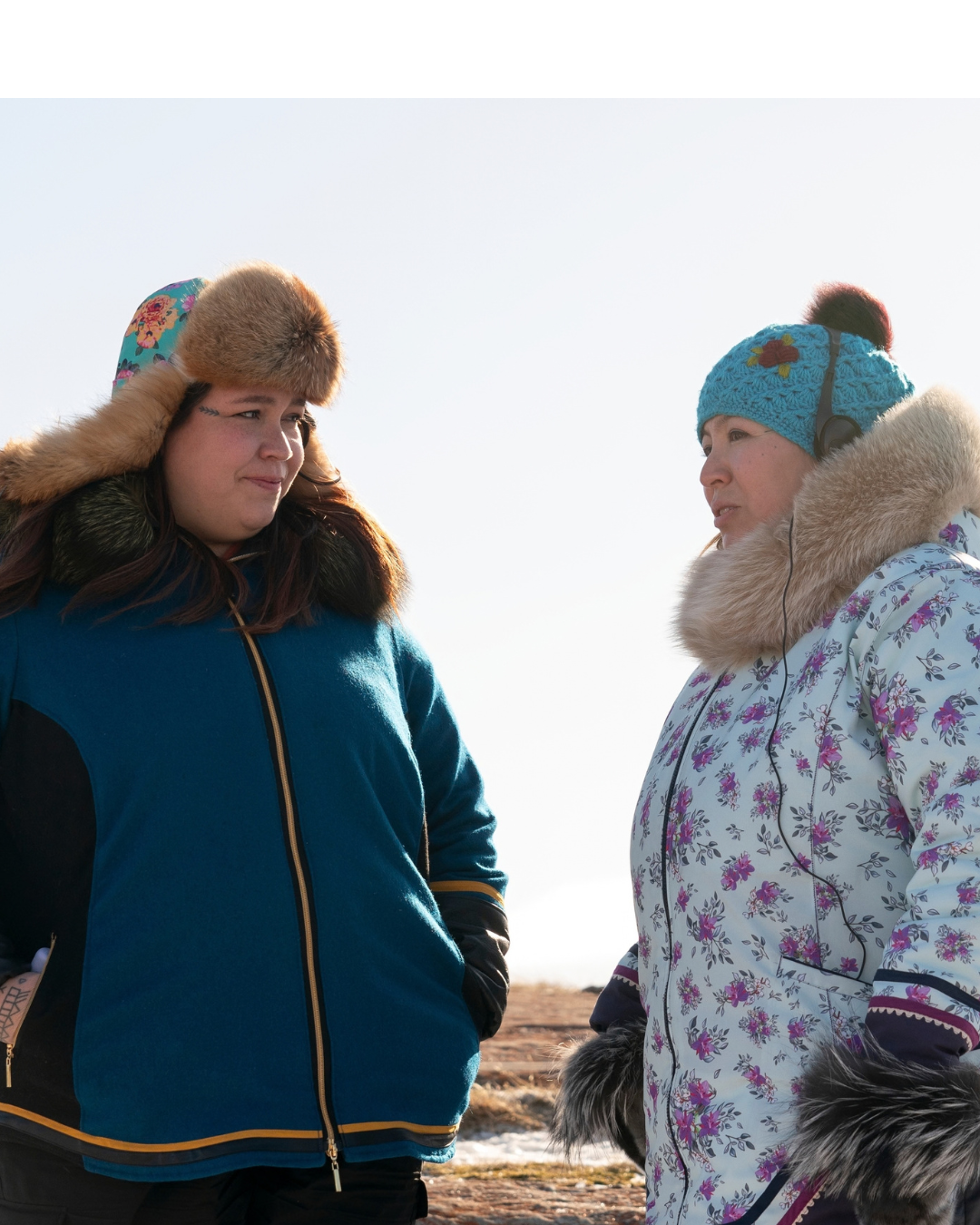
Some of the funniest television right now is coming from the top of the world. On the Matriarch Movement podcast, host Shayla Oulette Stonechild sat down in Tkaronto with Stacey Aglok MacDonald and Alethea Arnaquq-Baril, the Inuk creators, executive producers and writers behind North of North, the APTN, CBC and Netflix comedy that has become a global breakout.
The series follows Siaja (Anna Lambe), a young Inuk mother who blows up her marriage in the tiny fictional Arctic town of Ice Cove, where everybody knows your business. Over an hour of laughter (and a few tears), Stacey and Alethea talked about the mothers who made them storytellers, the 20-year friendship behind Red Marrow Media, and why they set out to make “the show colonizers never knew they wanted.”
Raised by Decolonial Badasses
Alethea was born and raised in Iqaluit back when it was still called Frobisher Bay, part of the Northwest Territories. It was a small, mostly Inuit town where Inuktitut was the main language, and she spent much of her childhood at her grandmother’s house, where her grandparents didn’t speak English.
Stacey was born in Yellowknife, because Nunavut has no hospitals for mothers to give birth in, and was back home in Kugluktuk at three days old. She still goes back every summer, when the town turns lush and green and people swim in the Arctic Ocean. Her mom ran a dog team (Stacey went to school by dog team for a while).
They describe their mothers as very different women who are both “decolonial badasses,” and say much of North of North was inspired by them. Shayla asked what matriarchy means in their communities, they explained that traditional Inuit leadership was fluid. Out on the land, the hunters are in charge; in the home, the mom is. It’s less about women ruling everything and more about being child-centred. And if you want to know who someone is, you don’t ask who their dad is. You ask, “Who’s your mom?”
A Google Search, a Workshop, a Company
Both women grew up surrounded by stories. Stacey credits her mom, a hilarious and sometimes scary storyteller, for her love of it: “Tell me that story about the shaman again, Mom.” Alethea’s dad was a CBC journalist, two uncles and an aunt were Inuktitut radio hosts, and her mom, an educator, would comb through explorers’ books to pick apart the white lens and point out where the outsiders got it wrong.
Their partnership started with a little internet sleuthing. When Stacey moved to Iqaluit, “the big, bustling city of 8,000 people,” to break into film, she Googled what was happening locally. Up came a photo of Alethea and a story about the development grant she’d won for her first film, Tunniit. Stacey filed her away as someone to watch for. Not long after, they met at a filmmaking workshop. One week later, they had started a company with two other Inuit women. Stacey didn’t tell Alethea about the Google search until about 20 years later.
“We Had to Become the Studio”
Their early work was a cultural documentary: shorts on reclaiming knowledge like building sealskin kayaks, and a series made with a friend who grew up in an outpost camp and was horrified to realize her son didn’t know how to light a qulliq, the traditional oil lamp. From there their paths split. Stacey stepped back to become a young mother, then returned to scripted work, including seven seasons of Qanurli and the short Throat Song. Alethea went on to make Angry Inuk.
No one was hiring young Inuit to produce, so they taught themselves. Alethea took jobs on projects by visiting non-Indigenous filmmakers to earn credits and a reputation. They organized and fundraised for their own workshops on everything from production accounting to camera, sound and colour correction. “We had to become the studio,” they said. They walked into government offices asking for six figures, spoke with total confidence, and paid themselves so little that, by one of their own accounts, she earned less than minimum wage for years. Both admit to lying awake worrying about “accidental tax evasion.”
They finally teamed up officially on The Grizzlies, based on a true story from Stacey’s home community. Afraid of getting such a sensitive subject wrong, Stacey begged Alethea to co-produce, joking that she needed “another Inuk scapegoat.” Alethea, who had sworn off producing for non-Indigenous directors, read the script, found it powerful, and said yes. The film’s heavy themes meant years of community aftercare, including arranging for therapists at public screenings. When it wrapped, director Miranda de Pencier told them: it’s your turn, what do you want to make?
Choosing Joy
The seed of North of North was Stacey’s idea, and it grew out of needing something lighter after years spent living inside The Grizzlies. Suicide is a reality their communities live with, they said, but it isn’t most of life in the Arctic. Most of it is relationship problems, family dynamics, beautiful parkas, and who made your kamiks and earrings.
They were also tired of people assuming they were stuck in the North, or asking why they didn’t move to Toronto if they were serious. “We choose to be up there because we love it,” they said. “It’s beautiful, it’s bright, it’s colourful.”
From day one, they wanted the show to be commercial, look expensive and stand up next to any comedy on TV. They pitched with a carefully curated deck and insisted on a real music budget for global pop hits, to show that Inuit are contemporary people too. Inuit are so often placed in the past by storytellers from away, they explained, but plenty of people up North are obsessed with Taylor Swift, and their grandmothers have loved ABBA forever. The deck’s final line: “Welcome to the show colonizers never knew they wanted.”
They went bold on the comedy, too. That infamous Season 1 kiss between Siaja and the stranger who turns out to be her father? With an intimacy coordinator, they shot a short, a medium and a long version, then used all three in the edit so it plays even longer. Anna Lambe watched the premiere sitting right next to them and squirmed the whole way through. “If you’re deciding to shock people,” they laughed, “you might as well go all the way.”
Season 2: Winter, and the Work of Mastery
Season 1 ran on the adrenaline of Siaja blowing up her life. Season 2 finds her months later in deep winter, when the snow has settled and she has to face harder questions: Who do I want to be? Who do I want to love? How do I raise my daughter and make life better for my community?
The creators chose one Inuktitut word as the season’s theme: Pilimmaksarniq, the practice of working toward mastery through observation, preparation and effort. Siaja is pushing her boss Helen (Mary Lynn Rajskub) for more responsibility, getting to know a half-sister she never knew she had, and open to love, or at least a hot date. As ever, she leads with her heart, jumps in with both feet and messes up with the best of intentions.
They say Anna Lambe has truly found the comedy this season. In Season 1 she found it hard to be goofy, especially since they shoot in her home community with her cousins, aunties and uncles working as extras. Once she saw how her performance landed in the edit, she locked in, and now she throws herself into the physical comedy.
The cast earns every laugh. Some big outdoor scenes were shot in temperatures near -40. While reviewing takes in the edit, they spotted frostbite starting to form on Zorga Qaunaq’s nose mid-scene. Between takes she’d cover it to warm up, then go straight back into character.
Fashion Like a Period Piece
In the Arctic, they pointed out, good clothing is the difference between life and death at -40, and Inuit have cared deeply about it for millennia. So they told their producers and networks to budget the costume department “as if it’s like a Victorian period piece.” No rentals, no cheap knockoffs and no sweatshops. Everything is made by real Inuit designers, and the costume department protects their patterns rather than sending them out into the world.
They were surprised when people asked if the fashion was heightened for TV. It isn’t. Go to the post office, the grocery store or daycare drop-off and you’ll see women dressed like Siaja all the time. Real-life parkas tend to be a bit more worn, since people mend them, swap out the fur and eventually hand them down to a niece. But the colour, the craftsmanship and the beauty are all real.
“We’re Proud of You”
Shayla asked how their own community has responded, the two got emotional. They recalled Anna Lambe observing that young Inuit girls today will never know a world without a global hit show with their people at its centre.
Both seasons were shot in and around Iqaluit, and Season 1 came with growing pains. The production closed roads, and crew members from the South didn’t know they couldn’t park where the water truck delivers to homes, prompting a few angry Facebook posts. The creators braced for criticism, knowing they’re “only two storytellers” and can’t please everyone. Instead, they say about 99% of the response was love, pride and excitement, and people were genuinely hooked on the story.
By Season 2, the whole town was in on it. Locals lent hunting gear and Ski-Doos as props, and hunters offered to spend a day hauling equipment up a hill instead of going out on the land. People driving past the set would roll down their windows to call out, “We’re proud of you. Good job.”
Don’t Wait for Permission
For young Indigenous women who want to make films, their advice was practical. You can make beautiful films on a phone now, so make lots of short films instead of spending years waiting on funding for one big project. Don’t be precious about them. Be careful about protocol and ethics, but creatively, “just do it over and over again.”
They also stressed building community. The people they took those early workshops with have worked with them for years, and youth they trained as teenagers have been on nearly every project since. And learn to take criticism. Alethea credits art school critiques for teaching her to hear notes as someone caring about your work. Stacey learned it through pages and pages of notes as a writer. Their favourite collaborators are the ones who will tell them plainly what isn’t working.
Looking ahead, they’d love to see more young Inuit men telling their own stories, to bring things back into balance. And they still rely on a bit of bravado. Before their first day in the writers’ room, they planned to arrive together, huddled in the women’s washroom for a pep talk, then walked down the hall wondering who they thought they were, and strolled in like they belonged. They did.
Meet the Creators
Stacey and Alethea joined forces in 2019 to launch Red Marrow Media, an Inuit-led production company. Between them, they bring decades of experience telling Northern stories on screen.
Stacey Aglok MacDonald
Stacey Aglok MacDonald is a film and television writer and producer originally from Kugluktuk, Nunavut, who has worked in the film industry since 2007. She is best known for Qanurli, the Inuit fan-favourite, Inuktut-language comedy series that ran for seven seasons on APTN. Her producing credits also include the feature The Grizzlies (2018), the multi-award-winning dramatic short Throat Song, and Slash/Back (SXSW 2022). Stacey lives in Iqaluit with her “much cooler, much wiser” 13-year-old daughter and their dog, Okpik.
Alethea Arnaquq-Baril
Alethea Arnaquq-Baril is a filmmaker from the Canadian Arctic who has been producing and directing since 2005. She directed and produced the award-winning APTN documentary Tunniit: Retracing the Lines of Inuit Tattoos (imagineNATIVE 2011), about the history and importance of traditional Inuit tattoos.
Her critically acclaimed feature documentary Angry Inuk follows Inuit finding new and provocative ways to respond to international seal hunting controversies. It premiered at Hot Docs 2016, won the Audience Choice Award there, was named to TIFF Canada’s Top Ten, and took the Social Justice Award at Santa Barbara, among other international honours.
In 2016, Alethea received the Meritorious Service Cross from the Governor General of Canada for her contributions to the arts and documentary filmmaking. That same year, the DOC Institute gave her its DOC Vanguard Award, recognizing her artistic sensibility and forward-thinking approach to the craft. She was also a producer on The Grizzlies (TIFF 2018) and Nyla Innuksuk’s Slash/Back (SXSW 2022).
Tune In
Listen to the full conversation on the Matriarch Movement podcast, part of Season 6: Indigenous Voices of This Generation, presented in partnership with the Indigenous Screen Office and YouTube Canada. You’ll hear how two Inuit filmmakers turned their own lives into one of television’s warmest comedies.
Seasons 1 and 2 of North of North are available on APTN, CBC and Netflix.
Explore

Seventh Generation Series
I'm Shayla, Founder, Advocate, and Champion of the Matriarch Movement—a non-profit online platform, podcast dedicated to amplifying the voices of Indigenous women and two-spirit individuals. Kahkiyaw niwâhkômâkanak, all my relations.
Tânisi!